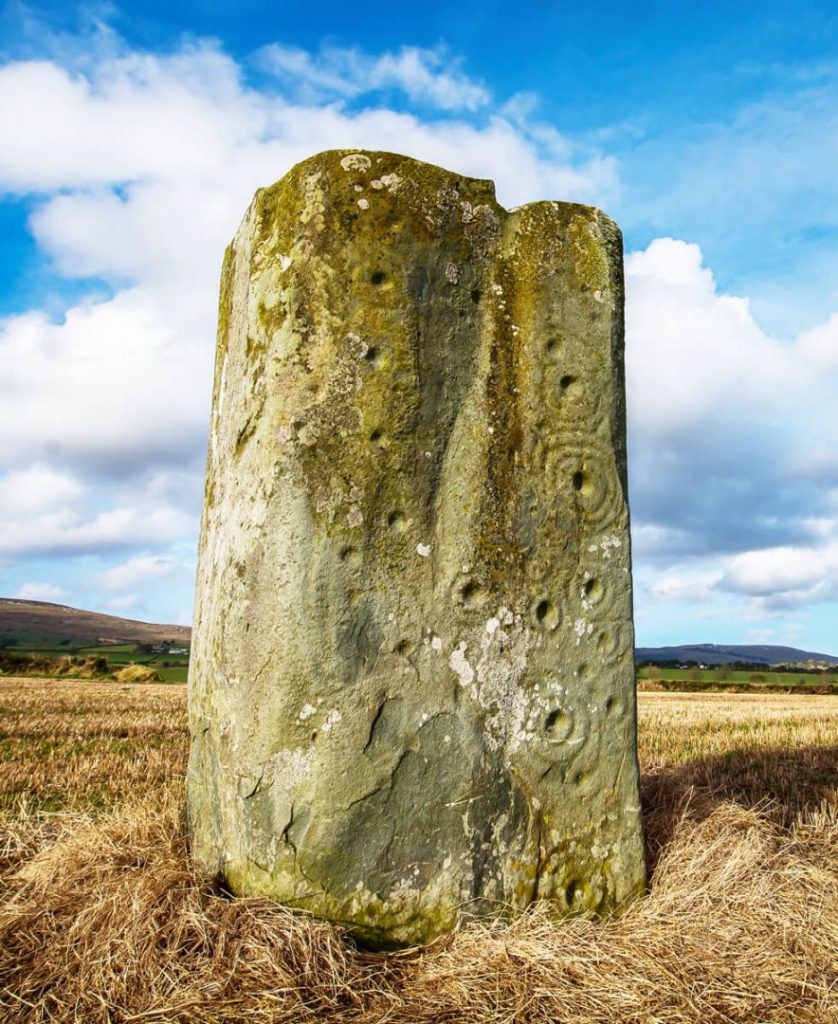
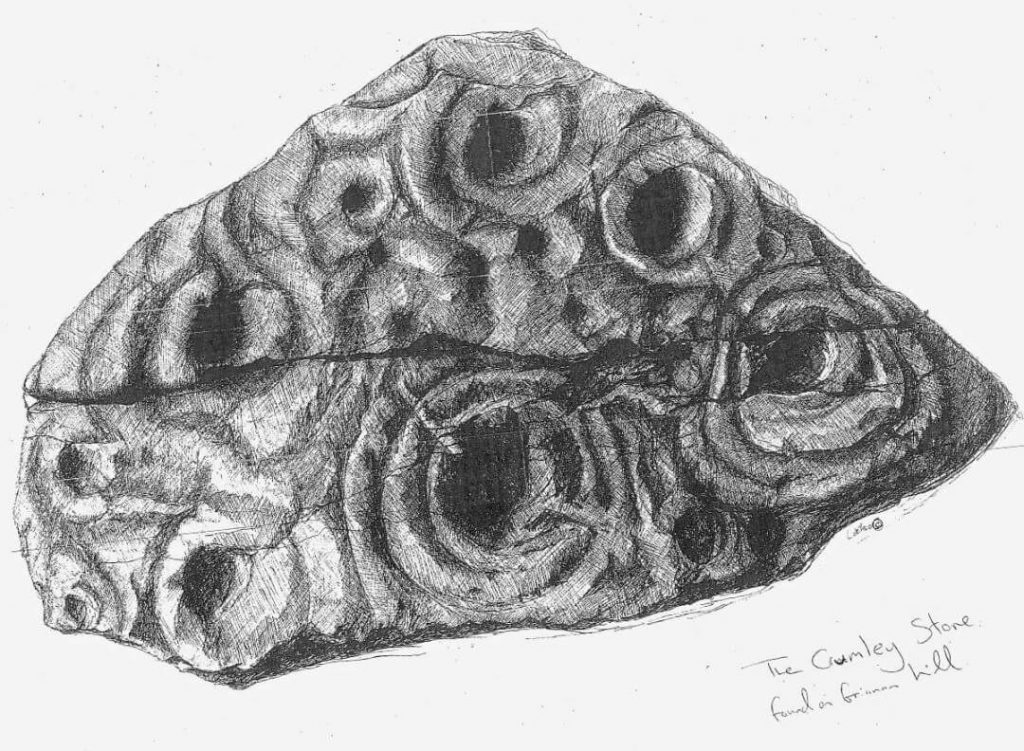
We found the articles in the Ulster Journal O Archaeology, Vol.51. 1988 on “Prehistoric Rock Art of Co. Donegal By M.A.M. Van Hoek Parts 1 & 2 very informative on the design details and locations of petroglyphs throughout Donegal. We have derived some of our rock art jewellery designs from the detailed sketches made by Van Hoek in 1986.
Many of the locations noted by Van Hoek have become naturally overgrown and can be very difficult to find. Without the local expertise and guidance from Liam McLaughlin we wouldn’t have been able to find these sites ourselves. Even then without the right lighting conditions, the motifs can be difficult to detect. Pouring water over the carvings helps to emphasize the details but bright sunlight with greater contrast of light and shade is necessary to achieve decent photographs.
We quickly realised that only by viewing these petroglyphs in person could we understand them properly. Lines that may have been mistaken for natural grooves and fissures in the rock on sketches or photos could clearly be seen to be carved with visible tool marks. Fine, tightly concentric rings with large flat bottomed central holes, indicative of bronze tool use can be found beside another style of carving which appears older. This style features smaller deeper cup-shaped marks surrounded by fewer wider concentric rings and looks like the ripples created when a stone is dropped in still water.
One of the Isle Of Doagh rock art outcrops Liam McLaughlin showed us was a site he had investigated in with his daughter Angela Mac Lochlainn and Bettina Linke at the request of the landowner. Here is an excerpt from an article about their finds along with some of their photos.
“Having now visited the panel on several occasions on which more photos were taken and the motifs closer inspected, of which Liam counted so far 52, we found that different hands were at work. This can be seen when looking at the style used to carve a motif. Some are clearly pecked with each individual, very small tool mark still visible within the motif while others are unmistakably smoothed out by hand and/or time, indicating that motifs on this panel are from different periods and more have been added over time to the composition we find today.
This of course raises the question if the people who added new motifs knew the meaning of the older ones which already could be 2000 years old by the time the newest additions were made. Certain motifs barely changed shape but that doesn’t mean necessarily that they still expressed the same concept. Some of the newer additions, like the very intriguing egg packs, may represent newer and unknown ideas to the original artists, like the introduction of metal would have brought, leading to potential changes in the mindset of people, their communities, their way of living as well as how they thought of themselves fitting into this new time in balance and probably agreement with their past.”