
Dazzled by diamonds? You’re not alone. From sparkle and shape to rarity and value, a world of factors influence the perfect gem for your dream piece of jewellery. When you discover what truly matters—and learn the insider lingo—you’ll shop with confidence and choose a diamond that delights you every time you wear it.
Diamond Guide
What is the difference between a natural diamond and a lab-grown diamond?
Lab-created diamonds and natural diamonds may look identical, but key differences matter. Both share the same chemical composition, hardness, and brilliance—making them equally durable and beautiful to the naked eye.
However, their stories set them apart. Natural diamonds are rare treasures, formed deep within the earth over billions of years under intense heat and pressure. Each one is unique and has become a symbol of everlasting love, admired for its rarity and history.
In contrast, lab-made diamonds are created in a controlled environment and can be produced in large quantities. They’re a budget-friendly option, allowing you to get a bigger stone for less money. But keep in mind, their resale value may not hold up over time.
If you value tradition, symbolism, and long-term investment, saving for a natural diamond might be worthwhile. If size and affordability matter more, a lab-created diamond could be a great fit.
What determines value in natural diamonds?
Each individual diamond’s beauty and cost will be influenced by its Colour, Clarity, Cut and Carat weight. Known as the 4 C’s, these qualities are use to grade the diamond and calculate its value.
What guarantee do I have that the diamond grading is correct?
Diamond grading laboratories are used to verify grading on individual diamonds. Their diamond report or certificate gives an independant guarantee of the diamond’s quality and value.
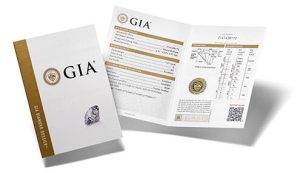
The Gemological Institute of America, (GIA) is an independant non-profit organization who developed the “4 C’s” diamond grading system to evaluate diamonds. The differences in diamonds can be so subtle, even a trained jeweler can’t recognize them without lab verification. A diamond grading report from an unbiased, scientific source such as GIA is proof of what you are purchasing.
Unfortunately, some labs have succumbed to pressure to lower their standards, allowing lower quality and lower priced diamonds to be presented with higher ratings. Use caution when comparing the price of diamonds graded by two different labs; what at first seems like a bargain may only be the result of more relaxed grading. Approximately 1 in 3 diamonds sold has been treated or “enhanced” in some way. Any treatment or “enhancement” made to a diamond lowers its value. Faller does not sell diamonds that have been treated in any way.
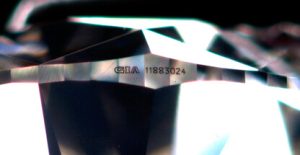
Every Faller diamond solitaire over 0.40ct has been certified by GIA, is accompanied by its GIA Dossier and will have the laser number inscribed on the diamond’s girdle. All smaller diamonds are graded to GIA standards.
What is the difference between diamond cut & diamond shape?
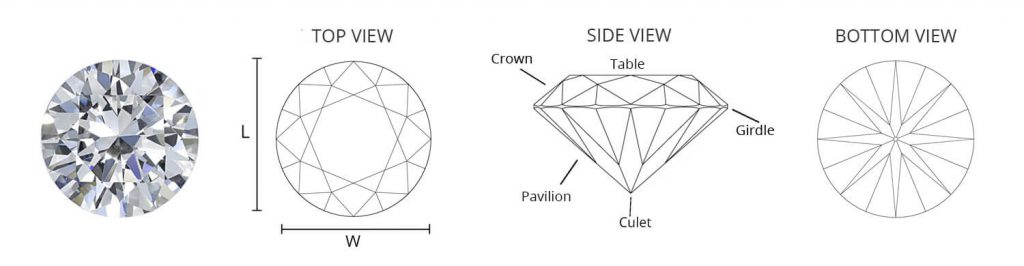
Shape refers to the diamond’s overall outline, whether it is round, square, oval, etc. Because these shapes are often called diamond cuts, it’s easy to confuse them with the cut grading system, which evaluates how well a diamond is cut to maximise sparkle and brilliance. Each diamond shape has characteristics that affect its suitability and appeal, and understanding those details will help you choose the right diamond shape for you.

Cuts and Shapes
-
Round
ROUND CUT
3/4 of all diamonds sold are round brilliant cuts, making them by far the most popular.
The ideal proportions of a round cut have been perfected over time to maximise light return (brilliance) and dispersion (fire). Advancements in technology have helped to produce the incredibly brilliant cuts we see today. A typical round diamond (for example, a 1.00 carat, F-colour, VS2-clarity, Ex cut) may cost 25-35% more than a similar fancy shape.
Round diamonds cost more per carat than fancy shapes for two reasons: demand for round diamonds is very high, and yield is relatively low because more of the rough stone is lost when cutting a round diamond than when cutting fancy shapes.
Coloured diamonds aren’t cut as round brilliants because it’s harder to see the colour in round diamonds, and colour is more important than brilliance in coloured diamonds.
Setting Factors
Round brilliant cuts are the most versatile of diamond shapes and can take many different types of setting styles. View our style gallery for some ideas.
-
Cushion
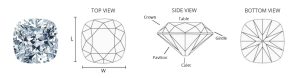
CUSHION CUT
The Cushion cut is a modern version of the old mine cut, the standard diamond-cutting style before the turn of the century. A cushion cut is a square or squarish-rectangular cut with rounded corners and brilliant-style facets. Cushion cuts are less brilliant than modern round brilliants but have more fire. Traditional cushion cut diamonds have steep crown and pavilion facets, usually a large culet and a small table and return light in a chunkier pattern than modern cuts. The cushion cut style has been refined over time, shrinking the culet, enlarging the table, and improving the cut angles for increased brilliance. Standards for cushion cuts vary more than for most other shapes.
Modern Brilliant Cushion cuts also have better symmetry, proportions, and polish, and can look most similar to brilliant cuts while offering a more unusual shape.
The Modified Brilliant Cushion adds an extra row of facets to the pavilion or bottom of the diamond. This gives them a “crushed ice” or needle-like facet pattern, more similar to a radiant cut than a traditional cushion cut.
Cushion cut diamonds come in various shapes, from those almost square to very rectangular. There is no right answer, so personal preference should dictate the choice. Rectangular cuts have less symmetry than squarer cuts and need greater depth (which translates to higher carat weight) to achieve similar brilliance, so squarer cuts are more cost-effective. With rectangular cuts, if the diamond is cut incorrectly, a bow-tie shadow will be evident across the centre of the diamond (similar to an oval cut). You need to examine the diamond in person under varying light conditions to ensure you do not have a persistent dark bow tie pattern.
Coloured diamonds are often cut as cushions as this shape maximises colour saturation.
Setting Factors
Rim settings accentuate their unusual shape, while claw settings make them appear more square/rectangular. Cushion cuts with more rounded corners are often set with double claws as they hold the diamond more securely. Cushion cuts are nearly as versatile as round cuts and can look very effective as side stones in trilogies and as a centre stone in halo rings.
-
Square - Princess cut
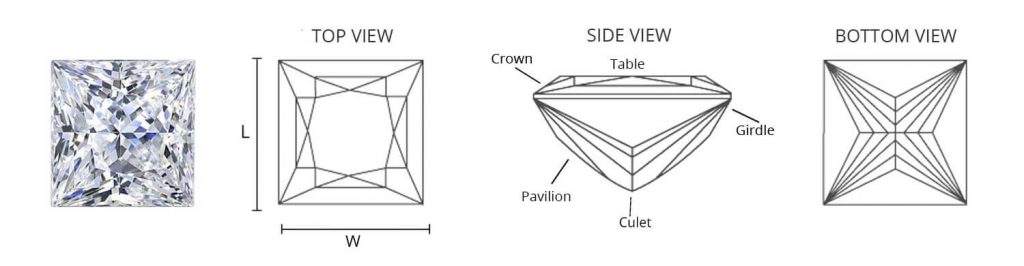
PRINCESS CUT
The princess cut is a square or rectangular modified brilliant diamond cut with a distinctive “crushed ice” or needle-like facet pattern. They are a popular fancy diamond shape because of its unique shape, sparkle, and relative price. This cut hides inclusions well because the extra facets disperse light. Cutting a princess from the rough crystal yields more than cutting a round diamond, which means lower prices for the princess. They display a more consistent brilliance and scintillation than other longer fancy shapes. On the downside, princess cuts have a smaller diameter than a round cut for the same carat weight, so they can appear smaller.
All other factors being equal, the more rectangular a princess cut diamond, the lower the price. A slightly rectangular princess with the longer length worn parallel to the finger is often preferred, as it can be more complementary.Setting Factors
Because the corners of the princess cut were at the outer edges of the original rough diamond crystal, you can often expect naturals, inclusions, and extra facets. The sharp, squared-off corners of the princess cut require great care when setting and need protection to avoid chipping or cracking. This is why a round claw tends to be much larger on a princess cut than on a round brilliant. We prefer “V”- shaped claws on the corners of a princess cut because they offer better protection. The princess cut is also commonly used in channel settings in diamond wedding and eternity rings because the stones sit side by side without any gaps between them. They are harder to set than round brilliants, so they cost more to set.
-
Octagon - Emerald Cut
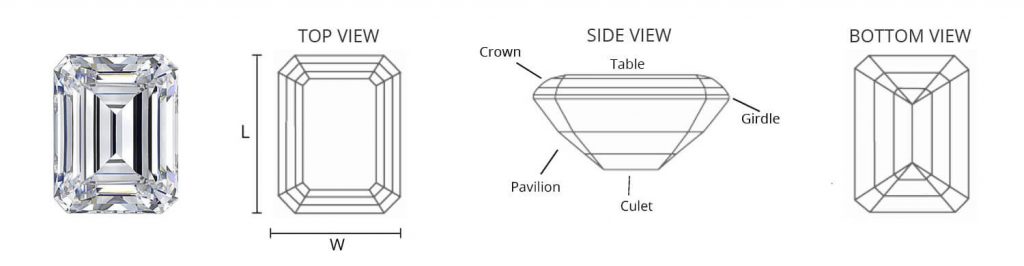
EMERALD CUT
A sophisticated and elegant classic diamond cut.
The emerald cut diamond’s unique look comes from its step-cut pavilion and large, open table. Instead of the sparkle of a brilliant cut, emerald-cut diamonds produce a hall-of-mirrors effect, with an interplay of light and dark planes. The emerald cut reveals a classic beauty and elegance not seen in other cuts. The look of an emerald cut diamond is subtle and understated, with less “flash,” or reflection and refraction. The shape was originally developed to cut emeralds, hence the name. Emerald cut diamonds are rectangular but can vary from nearly square to very long and narrow. The classic emerald cut diamond has a length-to-width ratio of around 1.50. If you prefer the look of the square emerald cut diamond, you should consider the asscher cut as well. Colour and clarity are easier to see in an emerald cut diamond, especially in larger stones, because the large, open facets let you see through the diamond. Allow at least one grade higher in colour and clarity than a brilliant cut to offset this.
-
Octagon - Asscher Cut
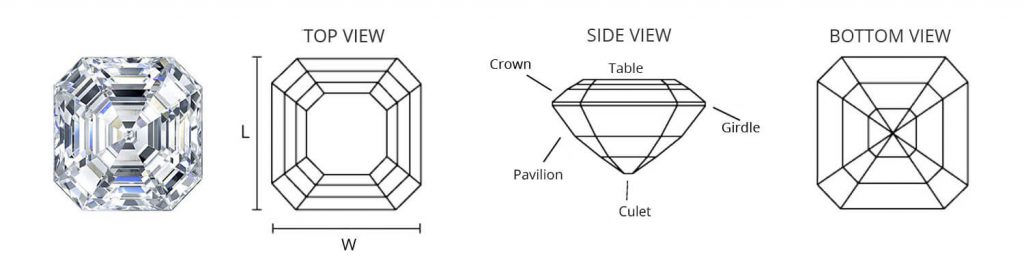
ASSCHER CUT
The Asscher cut is a squarish step cut with deeply cut corners, giving it an octagonal outline. It differs from an emerald cut by having a higher crown, a deeper, bulging pavilion, a smaller table, and larger step facets. These features give it more brilliance and fire than an emerald cut. A well-cut asscher will appear to have concentric squares as you look down through the table. The depth of the cut means the Asscher has the smallest size per carat of all the fancy shapes. Each stone must be seen and evaluated individually; there is no standard pricing for this type of stone since most are unique. Like all diamond shapes, picking the “best” Asscher means finding the right balance of beauty, size and price. Colour and clarity are easier to see in an Asscher cut diamond, especially in larger stones, because the large, open facets let you see through the diamond, so you can allow at least one grade higher in colour and clarity than with brilliant cuts to offset this.
Setting Factors
Because of the deep, bulging pavilion, the Asscher cut doesn’t lend itself to a flush fit (where the engagement ring sits flush with the wedding ring). The setting needs to be taller and more vertical than other diamond shapes, so if you want a narrow band, you often need a shaped-to-fit wedding ring.
-
Octagon - Radiant cut
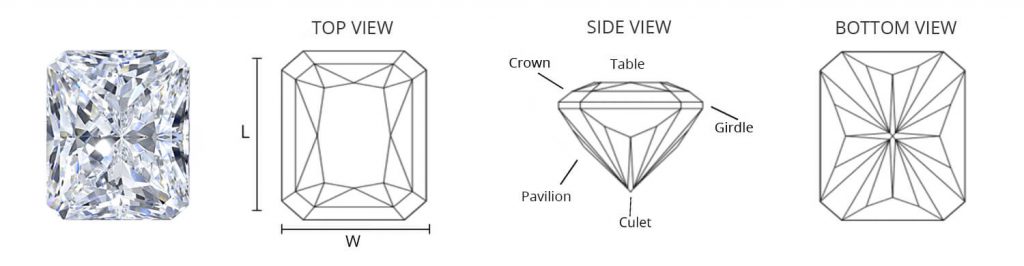
RADIANT CUT
The perfect cut for those who want maximum brilliance in a square or rectangular shape.
The radiant cut is a cut-cornered, rectangular or square modified brilliant. They have (in common with princess cuts and some cushion cuts) a distinctive “crushed ice” or needle-like facet pattern and, as a result, have much greater brilliance and fire than the emerald or asscher cut. A square cut radiant will have better sparkle than the princess cut. With the increase in popularity of square cuts, radiants are now more commonly cut square or nearly square. In longer, rectangular radiant-cut diamonds, a bow tie effect is more likely (though not as common as in oval, marquise, and pear cuts). Rectangular diamonds have less symmetry than square diamonds and need greater depth (which translates to higher carat weight) to achieve similar brilliance, so squarer cuts are more cost-effective. With no recognised standard for proportions, cut quality varies considerably, as the cutter tries to achieve maximum yield from the rough crystal. Personal evaluation and comparison of a selection of radiant cuts is the best way to judge their individual beauty for yourself.
Coloured diamonds are often cut as radiant cuts, as this shape maximises colour saturation.
Setting Factors
The claws securing a radiant are less obtrusive than those required for the sharp corners of a princess and tend to give a more pleasing result, so they are a great alternative to a princess solitaire. The cropped corners also help to minimise chipping. Radiant cuts can look very effective with various side-stone options in trilogies and as a centre stone in halo rings.
-
Oval
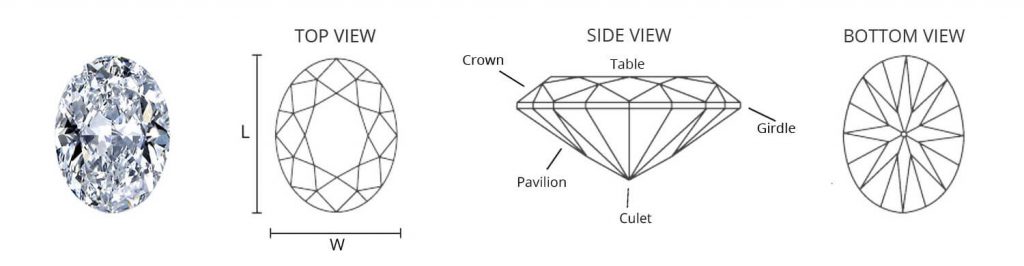
OVAL CUT
The oval modified brilliant cut is like a stretched round brilliant cut, with similar fire and brilliance to a round cut, except “stretched” facets can leak light across the centre, creating a darker area known as a bow tie. This can vary from near invisible to severe. You can only judge the severity of a bow-tie by personally viewing the diamond. Like all fancy shapes, there is no ideal cut in terms of proportions, but the classic oval cut has a length-to-width ratio of 1.35–1.50. A thinner oval can work well in a trilogy ring, and a wider shape may suit a solitaire better, but finger proportions will also influence suitability. Apart from the minimum of bow-tie, personal preference should be the main deciding factor. The oval is a good option if you want something like the round brilliant but a little more unusual. With a larger surface area than the round cut at the same carat weight and a lower price point, ovals deliver great impact on a tighter budget. Allow at least one grade higher in colour than round brilliants, as ovals appear yellower because of their shallower cut. The oval cut diamond’s elongated shape can make the wearer’s finger appear longer and slimmer.
-
Pear
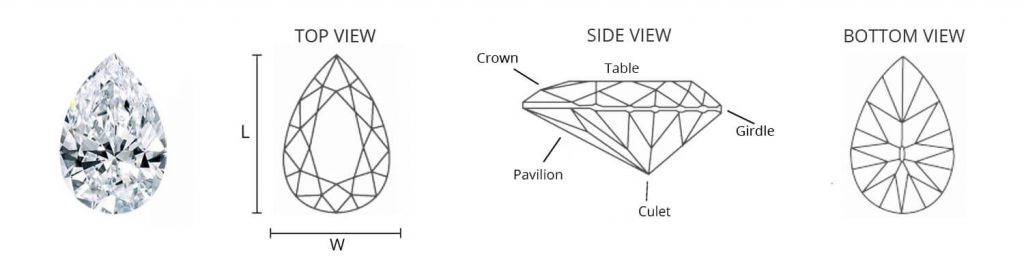
PEAR CUT
The pear cut is a modified brilliant cut that combines a round and a marquise shape, with a tapered point at one end. Like marquise cuts, a pear-shaped diamond should possess excellent or very good symmetry, with uniform, symmetrical curves and the point lining up with the apex of the rounded end. The classic pear-shaped diamond has a length-to-width ratio of 1.40-1.70, but like other fancy shapes, the cutter will have tried to obtain maximum yield from the rough crystal, so a variety of slim-to-wide cuts exist. Pear-shaped diamonds possess some degree of bow-tie, varying from near invisible to severe. The only way to determine the extent of bow-tie is to view the diamond in person. In rings, finger length and appearance, the setting orientation and ring style, and whether it’s a solitaire or multi-stone can all influence whether you prefer wider or more slender pear cuts. Pear cuts also make attractive side diamonds in trilogy rings. Pear cut shapes make very attractive pendants and drop earrings. Always look for at least one grade higher in colour than round brilliants, as pear cuts appear yellower because of their shallower cut.
Setting Factors
Because the pointed end of the pear cut is close to the outer edges of the original rough diamond crystal, you may find naturals, inclusions, and extra facets there. Setting requires great care, and the point needs protection to avoid chipping or cracking. A “V”- shaped claw is used to provide protection. A pointed tip with insufficient girdle thickness presents durability problems. In contrast, an extremely thick girdle can make setting difficult and hide weight below the girdle, where you cannot see it.
-
Marquise
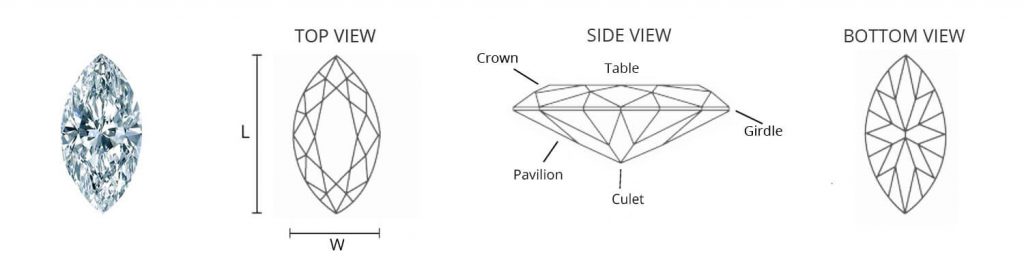
MARQUISE CUT
The marquise cut is a pointed oval, modified brilliant cut. Like pear cuts, a marquise-shaped diamond should have excellent or very good symmetry, with the two pointed ends correctly aligned and uniform, symmetrical curves. A length-to-width ratio of 1.75-2.15 is considered the classic marquise shape, but like other fancy shapes, diamond cutters will try to obtain maximum yield from the rough crystal. As a result, a variety of slim-to-wide cuts exist. Personal preference should dictate the choice. Marquise cuts possess some degree of bow-tie, varying from near invisible to severe. The only way to determine the extent of the bow-tie is to view the diamond in person. Carat for carat, the marquise diamond has one of the largest surface areas of any diamond shape. Because it is long and narrow, it can also create the illusion of greater size, making it great value for money. Like the oval diamond, the marquise-cut diamond’s elongated shape can make the wearer’s finger appear longer and slimmer. Always look for at least one grade higher in colour than round brilliants, as marquise cuts can appear yellower because of their shallower cut.
Setting Factors
Because the pointed ends of a marquise cut were nearest the outer edge of the original rough diamond crystal, you can sometimes expect naturals, inclusions, and extra facets there. Setting requires great care, and the points need to be protected by “V”- shaped claws to reduce the risk of chipping or cracking. A pointed tip with a very thin girdle can reduce durability, while an extremely thick girdle can make setting difficult and hide weight below the girdle, where you cannot see it.
-
Heart
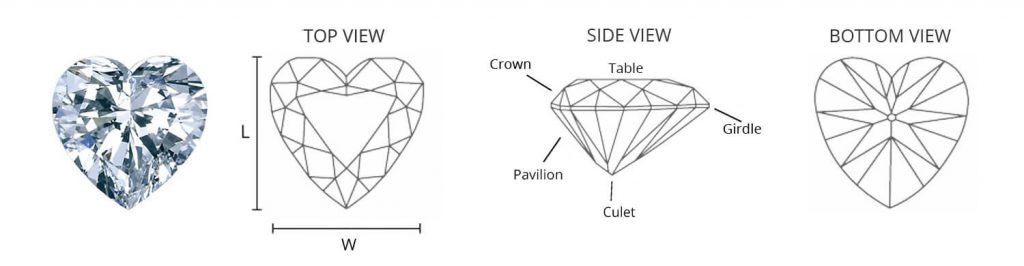
HEART CUT
For the incurable romantic, the modified brilliant-cut heart-shaped diamond is the perfect symbol of love. When choosing a heart, symmetry is a key characteristic, since the two halves must be identical. The cleft (between the two lobes) should be sharp and distinct, and the wings (the sides as they curve down to the point) should be slightly rounded.
Setting Factors
Heart-shaped diamonds under 0.50ct may not be a good choice, as the heart shape is harder to see in smaller diamonds, especially when set in claws. If claw-set, one claw on each lobe and one claw at the point will better show the heart-shaped outline. A rim setting will show off their unique shape better.
Are yellow diamonds valuable?
Diamonds can come naturally in almost any colour, including purple, pink, red, blue, green and grey. Many of these colours are incredibly rare and highly valued.
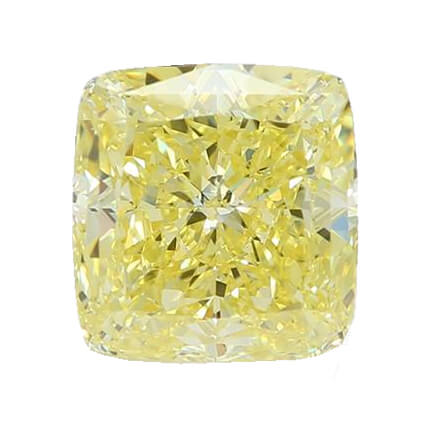
Yellow diamonds make up 50%-60% of all naturally coloured diamonds. Their value increases with yellow intensity. From Fancy Light Yellow, Fancy Yellow, Fancy Intense Yellow to Fancy Vivid Yellow (also known as Canary Yellow). Darker yellow diamonds then decrease in value.
Canary diamonds are usually the most valuable and can cost more than a white/colourless diamond of the same shape and size. Yellow diamonds can also have brown, green and orange tones, and these are less valuable than true yellow diamonds. Yellow diamonds aren’t cut as round brilliants, as it’s harder to see the colour in round diamonds. Many are radiant or cushion cut, as these shapes maximise the colour saturation.
Yellow diamonds are mainly found in Africa, including Angola, Central Africa, Congo, and Sierra Leone, but have also been discovered in Brazil, Australia, and Borneo.
While naturally occurring coloured diamonds have significant value, many near-colourless diamonds are colour enhanced. Irradiation creates vivid yellow, blue, green, and black colours. HPHT (high pressure with high temperature) results in yellow or purple-pink hues. Irradiated yellow diamonds usually come in orange-yellow and darker shades of yellow colour, whereas HPHT-processed yellow diamonds tend to be bright yellow. These are nowhere near the value of natural yellow diamonds.
Are the diamonds ethically sourced?
We guarantee that all Faller diamonds are natural (not factory-manufactured, lab-grown or created ) and mined from legitimate sources not involved in funding conflict and in compliance with UN resolutions. We hereby guarantee that the diamonds are conflict-free based on personal knowledge and/or written guarantees.
How do I care for my diamonds?
Diamond jewellery will last a lifetime with proper care. As with any gemstone, buildup under a diamond will reduce its sparkle. To maintain your diamond’s brilliance at home, soak the jewellery in a bowl with four parts warm water and one part household ammonia for no more than ten minutes. Brush very gently with a very soft brush, dip it back into the solution, rinse and leave it to drain on some tissue paper. Paper tissues can leave fibres and dust on the ring and are therefore less suitable for drying than jewellery cloths or other lint-free fabrics. Alternatively, you can use a hair dryer on a low setting from an appropriate distance to air-dry your diamond jewellery and avoid water spots.
It is not advisable to use ammonia on other gemstone jewellery. Check out our Jewellery Care Guide for advice on how to care for gemstone and diamond jewellery.